The Missing Layer Between AI Agents and Company Data
I am building Mainmind: a governed knowledge layer that gives people and AI agents the same account of how a company works, without trapping that knowledge inside any model or application.
- Mainmind
- AI Agents
- Knowledge Architecture
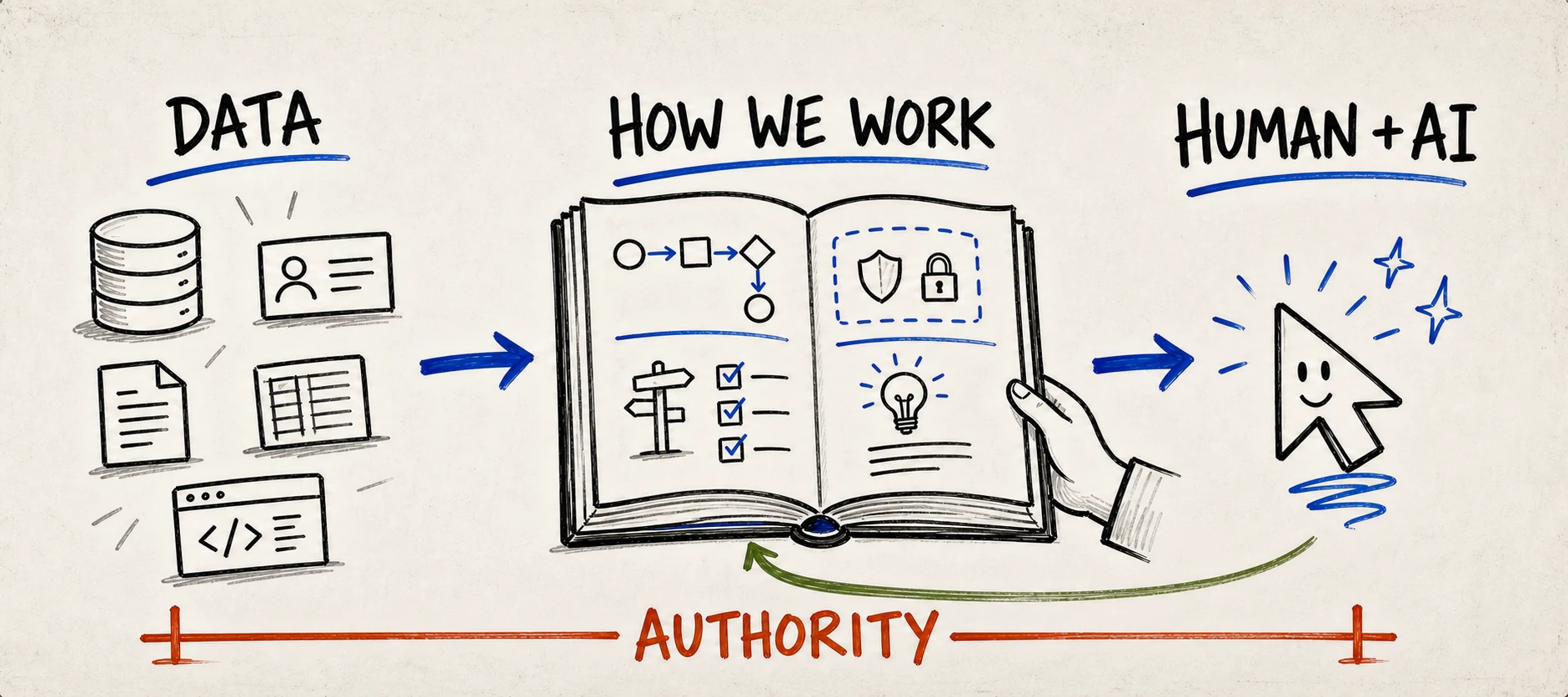
Most conversations about enterprise AI jump directly from data to intelligence.
Connect the model to the CRM. Give the agent access to the help desk, the document drive, the data warehouse, and the source repository. Add retrieval. Add tools. Let the model reason over whatever comes back.
That can make an agent more informed. It does not make the agent part of the company.
An order system can tell an agent what a customer bought. It cannot tell the agent why this company makes an exception for a long-standing customer. A ledger can show the balance. It cannot say who may approve a credit, what evidence they require, or which past decision changed the rule. A document search can find a policy. It cannot reliably establish whether that policy is current, who it applies to, or what should happen when reality no longer fits it.
Those are not data-access problems. They are organizational-knowledge problems.
I am building Mainmind to explore that missing layer: a governed architecture between a company’s systems of record and the people and AI agents doing the work.
Data Is Not the Organization
Every business already has systems that own important facts.
The storefront owns orders. The help desk owns conversations. The ERP owns inventory and accounting records. The bank owns money movement. GitHub owns repository state. These systems should continue to own those facts.
Trying to copy all of that into one giant AI database would create a second, usually staler version of the company.
But none of those systems owns the full answer to how this organization works. That answer is distributed across process documents, approval habits, role boundaries, old decisions, recurring exceptions, lessons from failed work, and the judgment of people who have been there long enough to remember why things are the way they are.
Humans absorb this through apprenticeship and shared history. Agents do not.
When an agent enters a workflow, we usually compensate by putting fragments of the organization into a prompt. Another agent receives a different prompt. A third gets a collection of documents retrieved by similarity. Soon each agent is operating from a slightly different company.
The missing layer should hold the durable operating knowledge that all of them need:
- purpose and priorities,
- roles and authority,
- processes and their boundaries,
- decisions and the reasons behind them,
- lessons from real work,
- provenance, ownership, and freshness.
Not every fact in the business belongs there. Not every piece of human judgment can be written down. But the parts that shape the next safe action should not have to be rediscovered in every session.
The Architecture Is a Loop, Not a Stack
It is tempting to draw three clean boxes: data at the bottom, knowledge in the middle, intelligence at the top.
That is useful as a first sketch, but a company does not only flow upward.
Work changes the world. Outcomes produce evidence. Evidence exposes weak processes and stale assumptions. People make judgments. Good lessons become better organizational knowledge, which changes how the next person or agent acts.
So I think of the architecture as a governed loop.
The Governed Company Loop
Facts Inform Work; Work Improves the Organization
Mainmind sits in the middle without pretending to own the systems, the actors, or the final judgment.This is the part I find most important: the knowledge layer should not merely help an agent answer questions. It should help the organization remain coherent as work passes between different agents, models, applications, and people.
One Company, Many Operators
Agent systems are becoming easier to create and easier to replace.
A support agent may use one model. A coding agent may use another. A scheduled operations agent may have no chat interface at all. Employees will bring their own assistants. Vendors will embed agents inside the software the company already uses.
If each of those systems owns a private copy of the company’s rules and memory, the organization fragments at exactly the moment it is trying to automate.
Mainmind’s job is to give every operator one governed way into the same company.
An operator should be able to orient itself, find the relevant process, read the current rule, understand its role, cite the source, perform visible work, and return a reserved decision to the person who owns it. The next operator should inherit the ruling and the lesson without needing the same model, prompt, or chat history.
The organization becomes the stable object. The agent becomes a replaceable worker.
That inversion matters. Models will keep changing. Interfaces will keep changing. The company’s identity, authority, and accumulated judgment should not disappear when one of them does.
Access Is Not Authority
Most agent platforms think carefully about access: which tools are available, which records can be retrieved, and which actions an identity can call.
That is necessary, but it is not sufficient.
An employee may have technical access to the accounting system without having authority to change a payment. A support agent may be able to draft a refund while a human still owns the commercial decision. A founder may delegate a process while reserving one class of exception.
Authority is an organizational concept, not only a permission bit.
The knowledge layer has to preserve that distinction. It should help an agent know not only what can I reach? but also what am I allowed to conclude, what may I change, and where must I stop?
In Mainmind, I want those boundaries to be part of the same knowledge that describes the work. When a decision belongs to a person, the system should narrow the ambiguity into one clear question, attach the evidence, and bring it back to the rightful owner. The agent can do the reading and make the argument. It does not inherit the right to rule simply because it is capable of asking.
Retrieval Should Be Disposable
This architecture still needs the machinery associated with modern knowledge systems: indexing, search, typed relationships, embeddings, ranking, access-aware retrieval, and connectors to the systems that hold live facts.
But that machinery should be a projection, not the authority.
The canonical organization should remain inspectable, versioned, and owned by the company. Mainmind can build faster views over it for agents and people. Those views can be discarded and rebuilt. Every material answer can name the version it came from. If the projection is stale, the system should say so instead of filling the gap with a plausible memory.
This is a deliberately conservative design choice.
Embeddings are useful for finding. They are a poor place to hide why a rule exists. A graph is useful for navigation. It should not quietly become a second source of truth. A chat history is useful for continuity. It should not become the only record of a decision that changes how future work is performed.
The fastest layer can be disposable because the important layer survives it.
Learning Without Silent Drift
A living organization cannot freeze its processes forever. It also cannot let every surprising outcome rewrite the rules.
Mainmind needs to support both stability and change.
When work reveals that a process is wrong, stale, unclear, missing, conflicting, or costly, the operator should be able to mark the strain without contaminating what the next operator reads as current policy. Evidence can become a lesson. A lesson can become a proposed change. A person with the right authority can accept, reject, or revise that proposal.
This creates a useful asymmetry:
- agents can observe and challenge freely,
- evidence can accumulate visibly,
- standing knowledge changes deliberately.
The organization learns from work without allowing inference to masquerade as policy.
Mainmind and Organizational Seed
I previously wrote about Organizational Seed, the open, file-based pattern underneath this idea.
The Seed is the portable organizational substrate: a small structure for purpose, authority, processes, records, decisions, and lessons. It is designed to remain useful even if every model and application around it is removed.
Mainmind is the product layer I am building to make that substrate usable as a shared surface.
It mounts the organization for agents. It makes ongoing work visible to people. It provides retrieval without replacing the canon. It carries questions to the people who must decide. And it gives the organization a governed path for turning experience into better instructions for the next run.
The distinction is important. Mainmind should make the company easier to operate, but it should never become the only place where the company exists.
What I Am Trying to Prove
Mainmind is still an early project. I am not trying to prove that one application can ingest an entire company and make it intelligent.
I am trying to prove something smaller and, I think, more durable:
One consequential process can be made legible to both humans and agents. The current company rule can be cited. The work can stay visible. Access can remain separate from authority. A reserved judgment can return to the right person with evidence. The result can improve what the next operator inherits.
If that loop works for one process, it can earn the right to support another.
The long-term ambition is a knowledge architecture that sits between systems and intelligence without trying to own either side: a stable organizational layer for a world of changing agents.
Systems of record hold what is true now.
Mainmind holds how the company works.
People and agents do the work.
Authority decides what may happen. Learning decides what the organization should become next.